
You can read the blog, or you can click on one of the icons below to listen to the podcast version! Click HERE for more listening options!




**Warning: Spoilers for both book and movie!**
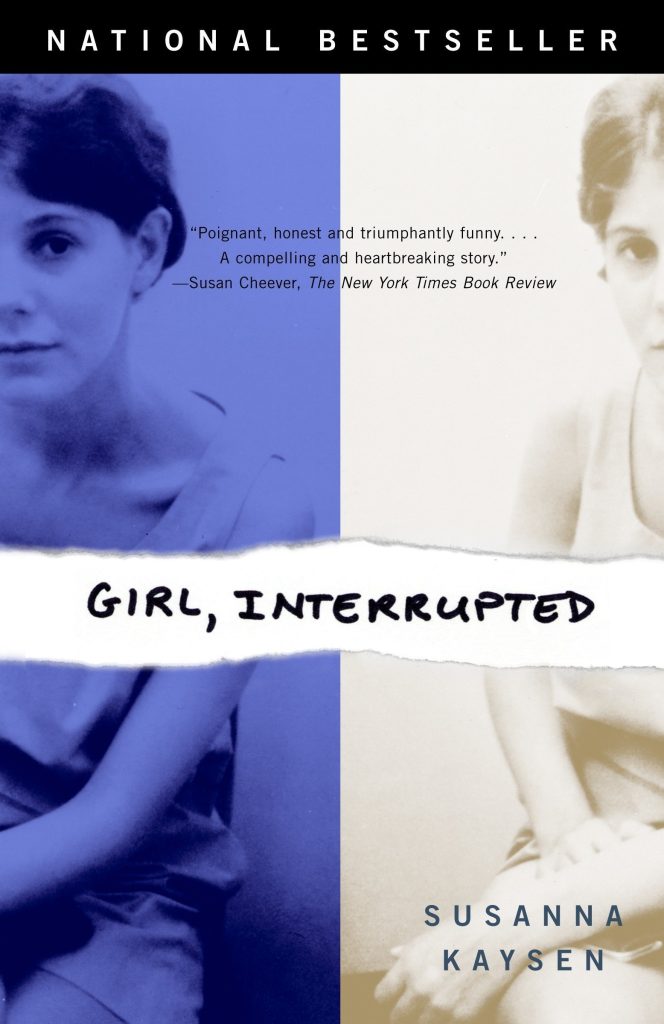
Girl, Interrupted by Susanna Kaysen (1994)
Girl, Interrupted directed by James Mangold (1999)
Synopsis
Girl, Interrupted is a memoir written by Susanna Kaysen about her 18-month stint at a mental institution when she was 18 years old. She tells a few of the more memorable stories that took place while she lived there and tells of the girls she meets-most notably a girl named Lisa. In the book she also goes into her life after being discharged, whereas the movie ends with her in the taxi driving away.
Thoughts on the book
Honestly, I wasn’t a huge fan of the book. It was just all right. It was really short, so there’s that. It isn’t written linearly; each chapter covers a different story she has to tell or talks about a specific person. She will have a chapter describing Daisy, and the chapter ends with her talking about Daisy’s death. Then a few chapters later, she talks about an event that happened that Daisy was part of. So, the timeline of her 18 months jumps around. I don’t have a problem with that layout, I just wasn’t taken with Kaysen’s story.
Movie version

Unlike myself, Winona Ryder was very taken with the book. She bought the rights to it and waited years till she was able to make it into a movie. She chose director James Mangold, who also went on to direct Walk the Line, 3:10 to Yuma, Ford vs Ferrari and some of the Wolverine movies.
The movie is much more eventful than the book, which is to be expected because the book wasn’t exactly exciting. There are two major changes, but for the most part it follows the book pretty closely.
Acting
Winona Ryder is in the lead role of Susanna. I like Ryder as an actress and she is good in this, however there are scenes where she definitely looks older than the 18 year old she is supposed to be. For some reason I also didn’t love her narration. Something about her voice and the way she talked sounded more like Winona Ryder and not enough like her character Susanna Kaysen.
Angelina Jolie won an Academy Award for her portrayal of Lisa. She was well cast and looks very much the way Lisa is described in the book. I of course knew of this movie and Jolie’s role and look; however, I wasn’t so familiar with it that I imagined her in my head while reading. Her acting really is incredible in this and deserved the nomination. During filming she would even avoid socializing, especially with Ryder, in order to keep that sociopathic mindset.

Susanna and Lisa are the main two in the movie, but some others that are worth mentioning. We have Elisabeth Moss in the role of the burn victim Polly. Moss of course went on to showcase her acting skills in the show Mad Men (which is one of the best drama TV series out there and is well worth watching). Brittany Murphy does an amazing job playing Daisy, a character who has a tragic end. But we’ll talk more about that later. Then of course there is Whoopi Goldberg who is well cast as the kind, but no-nonsense nurse Valerie. Lastly, we have Jared Leto who is in about 10 minutes of the movie and plays Toby. In the book Toby was her actual boyfriend, but in the movie he’s a guy she hooks up with. About ten years ago or more, I watched part of this movie because I was in Jared Leto phase. Needless to say, I was very disappointed to discover he was in such a small portion of the movie! Leto has gone on to be an Academy Award winning actor, as well as still being in his band 30 Seconds to Mars. If you want to hear about another movie with Jared Leto, check out my House of Gucci true story-book vs movie!
Oh, and an even smaller character is the guy Susanna makes out with later in the film, played by Misha Collins. Supernatural fans will recognize him as the actor that plays Castiel. Side note-I got into Supernatural back in like 2007, I loved the first two seasons, the third season was all right, then after the fourth season I stopped watching. Crazy it has kept going all these years! It just barley ended after like 15 seasons! That’s insane. Anyway, back to Girl, Interrupted.

The Biggest Differences
Lisa
There are three major differences between book and movie. The first is Lisa. In both book and movie Lisa is a sociopath who is very skinny and has yellowish skin. The book Lisa also doesn’t sleep, though she is much calmer at night and will even make hot chocolate for whoever else is up. In both, she frequently runs away, but is always caught. In the book, after one escape she is put in solitary and when she comes out, she is catatonic and just sits in front of the tv (prior to this, she was very against TV and would often shut it off while people were watching it). Then one day they wake up and see that all the lightbulbs have been taken out and stuffed in a closet. Turns out Lisa was faking it I guess and was just plotting what she could do to get revenge. This scene isn’t in the movie, though we do see Lisa get put into solitary.

Lisa and Susanna are friends in the movie, but in the book, Susanna was closer with her roommate Georgina. The book had another girl named Lisa Cody, who became close with Lisa. Though over time, their friendship became more of a competition to show who was crazier. Lisa manipulates Lisa Cody and when Lisa Cody gets out, she becomes a “real junkie” as Lisa puts it. Lisa Cody isn’t in the movie, and that friendship is sort of replaced with Susanna. Which makes sense for the movie, since Susanna is the main character. An example being, the movie has a scene where Lisa is talking to Susanna over the phone, while they are in phone booths right beside each other. This is something Lisa and Lisa Cody would do.
Lisa is kind of the ringleader in the book and is very much the leader in the movie. In the movie, she and a select group of girls will get out in the middle of the night and hang out in the tunnels and sometimes break into the offices. None of this happened in the book. The tunnels are one of the chapter titles though. In the book the tunnels are a way of getting between buildings, and the nurses will use them with patients. It isn’t some secret area the way they have it in the movie.
Daisy and her death
Daisy is in both the book and movie but there are some changes in regard to her stay at the hospital as well as the details of her death. In both, she is at the hospital and her dad will bring her rotisserie chickens which she eats in private. She’s hooked on laxatives and at one point Lisa is able to get into her private room by giving her laxatives in return. She also ends up leaving and moves into an apartment her dad gets for her.
In the book, Daisy was only a part time patient. She would check in in November and then leave after the holidays. The movie has her discharge as a very dramatic moment, but in the book, it wasn’t, because she would always leave, then come back later in the year. The movie has Susanna be the one who uses laxatives to get into her room, then Lisa pushes herself in. While in there, Lisa spies the rotisserie bones under her bed and when she points it out, Daisy is very embarrassed. She says that when she gets to five, Valerie makes her throw them out. In the book, Lisa is the only one who gets in the room, and she tells them that Daisy has 12 eaten chickens laid out (not hiding them) and tells Lisa that when she gets to 19 is when she leaves.

In both, Daisy talks about how she is moving into an apartment that her dad got for her. In the movie, we overhear her describing the apartment to someone while they are in the ice cream parlor. The way she describes it in that scene is the same way she talks about it in the book. (While on the topic of the ice cream parlor, in the book they do go on an outing to get ice cream, but it’s pretty uneventful. In the movie, when they are there a woman Susanna knows sees her there, and there is this whole scene where she is mean to Susanna, and then Lisa and everyone else drives the woman away).
In the book, the hospital gets word that Daisy has committed suicide, and everyone is upset about it.
The movie turns this into a more pivotal moment. They have Lisa and Susanna escape and go to Daisy’s to rest before continuing on their escape. While there, Lisa torments Daisy with all sorts of mean comments while Susanna covers her ears because she doesn’t want to hear the horrible things Lisa is saying. In the morning, Daisy has a song playing on repeat, and Susanna goes upstairs to check on her. She ends up finding Daisy’s dead body and goes into hysterics (understandably). Meanwhile, Lisa comes upstairs and is of course not sympathetic whatsoever and even checks Daisy’s pockets for money. This is the most powerful scene in the movie and is so well done. Murphy is amazing as Daisy and the scene when Lisa is insulting her is also so incredible. Not just because of Jolie’s monologue, but Murphy’s acting throughout. And Ryder and Jolie give powerful performances (and couldn’t be more different) upon seeing her body.
Murphy, sadly, also died at a young age. When she was just 32 she died of pnemonia but she also had various perscription drugs in her system.

After taking Daisy’s money, Lisa then leaves, but Susanna stays and calls the cops and is taken back to the hospital.
She ends up having a break-through and because of that experience she opens up more in therapy and actually makes progress in her recovery.
Lisa does get caught once again though, and the final dramatic scene in the movie is Lisa stealing Susanna’s journal and sharing what she has written about all of them. This part plays out like a scary movie and even has Susanna running away from Lisa. I expected Lisa to end up dying. I thought she would accidentally fall or something, but instead they just have this moment of being straight with each other and Lisa breaks down crying. (Which based on my limited knowledge, are sociopaths able to feel hurt by what others say? Thus causing them to cry the way Lisa does? If anyone knows the answer to this, let me know).
The next day, before Susanna leaves, she goes to see Lisa, who is strapped into a bed. They have a close moment and Susanna tells Lisa that she will get out and when she does to find her. This moment, as well as the part with Lisa crying, makes it seem like she’s been “cured” but again, as far as I know, a sociopath can’t suddenly ‘recover’ like that and start having feelings like that of your average human. That’s a complaint I have with Hollywood in general, is making things end too “perfectly”. Some mental issues can be treated, but it doesn’t just go away. They don’t say that Lisa is all better, but it sort of implies it. But I don’t know. I’m not a psychologist, and maybe my opinions are all wrong.
The book doesn’t have any of this happen. Like I said though, the book is just a memoir that is a series of different stories. There is no climax or anything like that, so it makes sense the movie had to change the story to create these climaxes.
Susanna’s healing and life after the hospital
In the movie, as stated above, Susanna has a cathartic experience which helps her open up and heal. You get out of therapy what you put into it, so when she actually puts in the work she begins to heal. Even though the movie shows her being diagnosed with borderline personality disorder, the movie makes it seem like it was a wrong diagnosis, and she just had some things she needed to work on in order to have better mental health. Rather than a mental illness that you can’t cure with therapy. She is discharged from the hospital because of the progress she has made and is going to continue her therapy twice a week. The book doesn’t have as uplifting an ending.
The book, however, does not have her cathartic experience. At some point in her stay, she is given privileges to leave and even has a job, she just has to come back at the end of the day. One evening she goes out with a friend and meets a guy who is a friend of a friend. Susanna isn’t smitten with him, but he takes a liking to her. As time goes by, he eventually proposes to her. Since she is engaged and now getting married, she is allowed to be discharged. Not much is said of her husband, because she wasn’t truly in love with him, and they eventually divorce. In a chapter of the book, she says that years later is when she read her hospital file and reads, she had been diagnosed with BPD. The movie shows her discovering her diagnoses while there, because one night they sneak out into the offices and break into their files and each reads their diagnosis. In the book she analyzes this diagnosis and feels like she was just going through what your average teenager experiences. Kaysen never says that she gained anything from the therapy she received while institutionalized and unlike the movie, I don’t see that she benefited from the experience.
The book also talks about how she kept in touch with Georgina and went and saw her and her husband (and a goat they owned). Eventually Georgina moved out of state and they lost touch. She then says that she once crossed paths with Lisa out in the city and she had a three year old son. After talking a bit, Lisa gets that mischievous sparkle in her eye and leans in and says, check this out, and proceeds to show her how her stomach can now expand due to having been pregnant. The movie keeps is pretty vague as to what happens to the other patients and who she does or doesn’t see again.
Minor Changes
One of the minor changes is that in the book her parents never visit her, but in the movie, it shows them doing a family therapy session.
Toby in the book was her boyfriend and it only mentions him visiting once. In the book she is also visited by her high school English teacher, whom she was having an affair with. He tries to convince her to run away with him, but she wants to stay. In the movie, Toby visits and he is the one that tries to convince her to run away but she declines.
The movie also portrays her affair with the teacher as a one-time thing, whereas in the book they went out several times.

This might not be considered as “minor” but the scene where Polly is put in isolation and Susanna and Lisa steal instruments and drug the head nurse so they can play to Polly to help her feel better also didn’t happen. The movie also has the male orderly who likes Susanna. In the book, Georgina is the one that has a boyfriend, but I think it was a guy who was also a patient not an orderly.
Valerie also has a much more prominent role in the movie. She is talked about in the book, but the movie she is there for some pivotal moments.
Polly is a bigger role in the movie, whereas Georgina kind of became a smaller role.
There is a chapter in the book where her wisdom teeth come in, and Valerie takes her to her dentist to have them removed. This happens shortly after Daisy’s death and Susanna is not doing well mentally. She kind of freaks out about having been put under and is upset about the time that was taken from her. Around this time, she also has a moment where she doesn’t think she has bones in her hand and bites her hand to find the bones. This ‘bones in hand’ thing is mentioned in the movie as well, but it takes place in the beginning before she overdoses on Asprin.
There is also a conversation about Wizard of Oz early in the movie, then as Susanna is getting better it is playing on the TV. It is the scene where Glenda is telling Dorothy she always had the ability to go home at any time, but she had to come to that realization herself. Dorothy then talks about what she had to learn before going home. This parallels Susanna’s experience in the hospital. How she always had the power to leave, but there were lessons she needed to first learn. I love a good parallel.
Book or movie?
In the end, I can’t say I loved either the book or movie. However, if I had to choose to reread the book, or rewatch the movie, I would probably choose the movie. The book just wasn’t too particularly interesting. I’m fine with books not having much of a plot, as long as it’s interesting and I’m learning something. I just didn’t get much out of the book at all. It wasn’t terrible, just meh. The movie was entertaining and the acting by everyone was stellar. This is one of those rare cases where it isn’t the book that wins, but the movie.